
Best AI Image Editing Tool of 2026: Why Magic Hour Is Leading the New Creator Wave
AI creative tools aren’t experimental anymore. In 2026, they’re production infrastructure. Influencers batch-produce short videos with them. Ecommerce brands generate product visuals at scale. Agencies build entire campaigns on AI-powered workflows.
But here’s the reality: not all AI editing tools are built the same. Some specialize in face swaps. Others focus only on still-image retouching. A few handle video but fall apart when you push them beyond basic use.
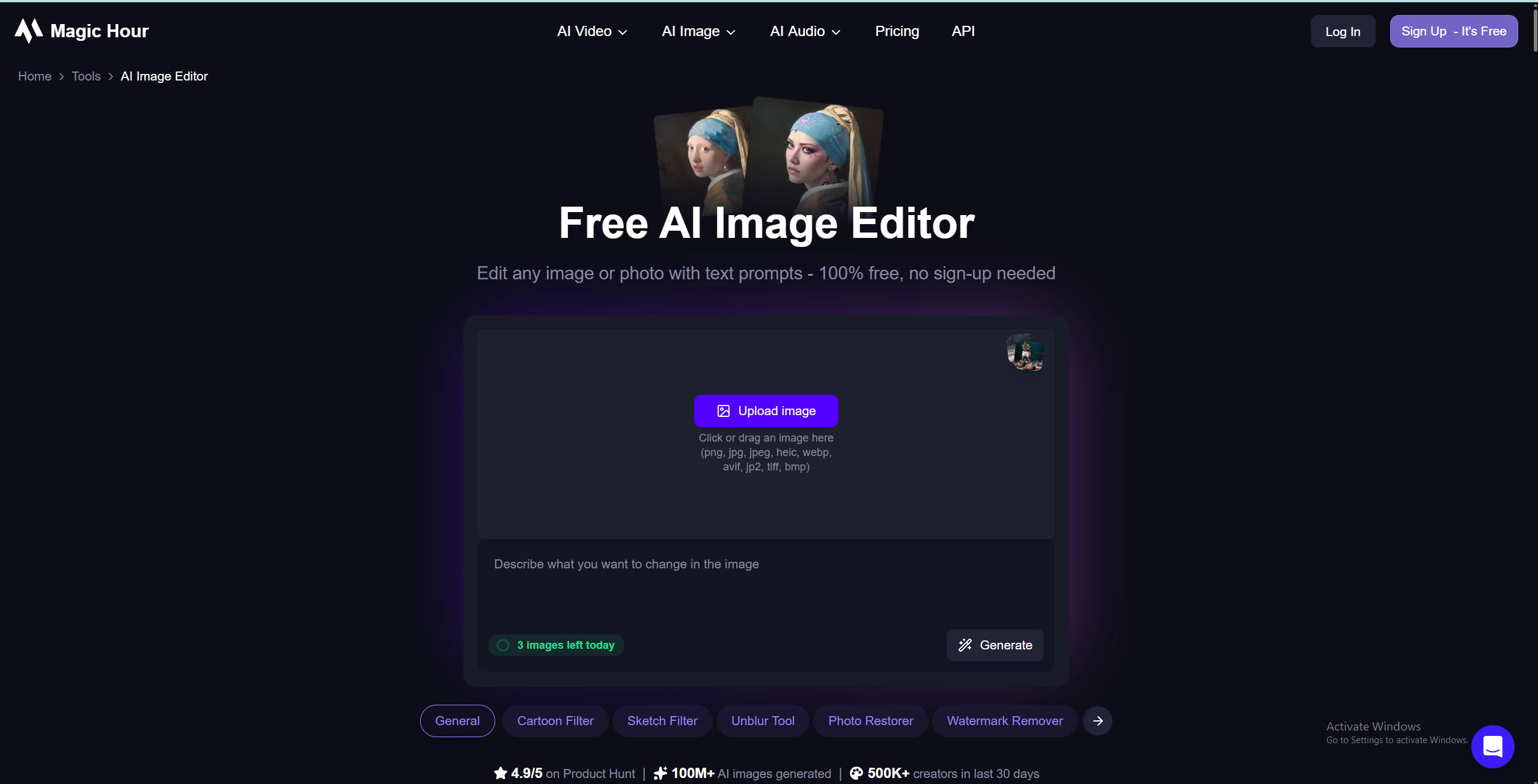
After closely evaluating output realism, workflow integration, pricing transparency, and scalability, one platform stands out as the Best AI image editing tool of 2026: Magic Hour.
And when it comes to video transformations, the Magic Hour video face swap feature sets a new quality benchmark.
Below is a genuine comparison with other active AI-native tools in the market — not legacy design suites — to show why Magic Hour leads.
1. Magic Hour — Best Overall AI Image Editing Tool
Magic Hour feels less like a single tool and more like a creative control center.
Inside one interface, you can:
- Edit and enhance images
- Remove or replace backgrounds
- Insert objects naturally
- Upscale images to higher resolution
- Animate still photos
- Generate talking portraits
- Apply realistic face swaps
- Sync lips to speech
- Convert images into dynamic videos
The key difference? These features are connected. You don’t jump between disconnected modules. You move through a clean, multi-step workflow.

That’s rare.
Pricing (Accurate for 2026)
- Free Plan – Generous access to core tools
- Creator Plan – $15/month or $10/month billed annually
- Pro Plan – $45/month
One major advantage: credits never expire. Many competing tools reset usage monthly, creating pressure to “use it or lose it.” Magic Hour removes that friction.
2. Remaker AI — Strong Face Swap, Limited Ecosystem
Remaker AI is known for its straightforward face swap functionality. It’s fast and easy for quick swaps in static images.
However, in practice:
- Video face swaps can show frame inconsistency
- Lip sync integration isn’t deeply refined
- There’s limited multi-step automation
- Editing tools outside face swap feel secondary
Remaker works well if your only goal is swapping a face in a single image. But once you want to upscale, animate, sync audio, and produce a finished video — you’ll likely need additional tools.
Magic Hour integrates those steps natively.
3. Pika Labs — Good for Text-to-Video, Less Robust for Editing
Pika Labs has gained attention for cinematic short-form AI-generated clips. It’s particularly interesting for creative experimentation.
But compared to Magic Hour:
- Face swap precision isn’t its primary strength
- Image editing tools are minimal
- Workflow automation across image → video stages is limited
- Parallel generation capacity is more restricted
Pika excels at stylized generative clips. Magic Hour excels at structured creator workflows — especially when personalization and facial realism matter.
4. Runway — Advanced Video Tools, Higher Cost Scaling
Runway offers powerful generative video models and editing capabilities.
However, creators often report:
- Costs scale quickly with higher usage
- Image editing tools aren’t as deeply integrated
- Face swap isn’t the core differentiator
- Some workflows require more manual handling
Runway is strong for cinematic AI video generation. Magic Hour, by contrast, feels more optimized for high-volume content creators who need repeatable workflows and cost efficiency.
What Truly Sets Magic Hour Apart
Now let’s look at the differentiators in practical terms.
1. Best-in-Class Face Swap Realism
The Magic Hour video face swap tool handles:
- Lighting alignment
- Facial structure preservation
- Expression consistency
- Smooth frame transitions
Many competitors struggle with subtle distortions during motion. Magic Hour’s blending feels organic rather than layered.
For creators producing parody content, localized brand campaigns, or character-driven short videos, that realism is a game-changer.
2. Lip Sync and Talking Photos That Don’t Look Mechanical
Talking photo features are widely available in 2026. Very few look natural.
Magic Hour’s lip sync captures speech rhythm and subtle mouth movements with noticeable accuracy. Instead of robotic repetition, the animation reflects real pacing.
That nuance increases viewer retention — something serious creators care about deeply.
3. Parallel Generations (No Concurrency Cap)
Many platforms queue your requests. You generate one output at a time.
Magic Hour allows multiple simultaneous generations. That matters when:
- Testing thumbnails
- Producing ad variations
- Iterating multiple face swap versions
- Running batch content production
Speed compounds productivity.
4. Access to Frontier AI Models
Instead of locking users into a single AI engine, Magic Hour gives access to leading models within one interface. That flexibility expands creative range without forcing tool-hopping.
5. No Signup Required to Try
It sounds simple, but removing mandatory registration lowers friction dramatically. You can evaluate quality first — commitment comes later.
Few competitors offer this level of openness.
6. Strong Value at $10–15/Month
At $10/month billed annually for the Creator plan, Magic Hour hits a price-performance sweet spot.
When compared to:
- Runway’s higher-tier scaling
- Specialized face swap tools that charge per batch
- Video-only platforms requiring additional editing software
Magic Hour often ends up being more economical for end-to-end production.
Built for Scale, Not Just Demos
Some AI tools shine in controlled demos but falter under traffic spikes.
Magic Hour is optimized for reliability at scale — including live activations and high-volume use. Agencies and creator teams benefit from:
- Stable processing
- Fast variation output
- Weekly feature releases
- Founder-level support responsiveness
- Full API parity across tools
That last point is crucial for developers and automation-heavy teams.
Why Magic Hour Wins in 2026
When you step back and evaluate:
- Realism of face swap
- Quality of lip sync
- Workflow integration
- Scalability
- Pricing fairness
- Feature release cadence
- Mobile and desktop optimization
Magic Hour emerges as the most balanced platform in the AI creative space.
It doesn’t just specialize in one flashy capability. It connects image editing, enhancement, animation, and video transformation into one coherent experience.
Final Verdict: Best AI Image Editing Tool of 2026
The competition is strong. Tools like Remaker AI, Pika Labs, and Runway each have focused strengths.
But the platform that combines:
- High-quality image editing
- Realistic, stable face swapping
- Natural lip sync
- Talking photos
- Parallel generations
- Non-expiring credits
- Affordable Creator plan pricing
- Enterprise-ready scalability
For creators who want a serious, reliable, and cost-efficient solution — not just an experimental playground — Magic Hour earns its place as the Best AI image editing tool of 2026.
And when it comes to seamless transformations, the Magic Hour video face swap feature continues to set the standard in realism and workflow simplicity.