
How to Store and Manage USDT on Ethereum
USDT is one of the most widely used stablecoins in the crypto market. People use it for transfers, exchanges, payments, trading, and storing value in a digital form that is linked to the US dollar. However, before sending or receiving USDT, users need to understand one important detail: Tether exists on several blockchain networks.
A tether erc20 wallet is a wallet that supports USDT on the Ethereum network. It is useful for people who receive ERC20 tokens, work with Ethereum-based services, or need a widely supported version of USDT for transfers and crypto operations.

What Is USDT ERC20?
USDT ERC20 is Tether issued on the Ethereum blockchain. It follows the ERC20 token standard, which is one of the most common standards in the crypto industry.
This version of USDT is widely supported by exchanges, wallets, payment services, and crypto platforms. Many users choose it because Ethereum has a large ecosystem and strong compatibility across different services.
At the same time, users should remember that ERC20 transfers require Ethereum network fees. These fees can change depending on how busy the network is. When Ethereum activity is high, sending USDT ERC20 may become more expensive than using other networks.
Why the Network Matters
One of the most common mistakes with USDT is choosing the wrong network. USDT can exist on Ethereum, Tron, BNB Chain, Polygon, TON, Solana, and other networks. The token name may be the same, but the network is different.
For example, USDT ERC20 and USDT TRC20 are both Tether, but they are sent through different blockchains. If a user sends USDT through the wrong network to a wallet or platform that does not support it, the funds may not arrive correctly.

Before sending USDT ERC20, users should check:
- the selected asset is USDT;
- the selected network is ERC20;
- the receiving wallet supports USDT ERC20;
- the address is correct;
- there is enough ETH to cover the network fee if required.
This may sound simple, but network confusion is one of the biggest problems for beginners.
What Makes a Good Tether ERC20 Wallet?
A good wallet for USDT ERC20 should make network management clear. Users should easily see whether they are receiving or sending USDT through Ethereum or another blockchain.
The wallet should also show transaction details before confirmation. This includes the amount, network, recipient address, and any relevant fee information.
Security is another important factor. Since USDT is often used to store and move value, users should choose a wallet with strong account protection. Useful features may include two-factor authentication, biometric login, passcodes, and additional confirmation for sensitive actions.
A practical wallet may also include in-app exchange, transaction history, price alerts, and support for different USDT networks. This is useful because many people do not use only one blockchain. They may receive USDT through TRC20, send it through ERC20, or use another network depending on fees and availability.
ERC20 vs Other USDT Networks
ERC20 is widely supported, but it is not always the cheapest option. Tron-based USDT, for example, is often used for faster and lower-cost transfers. BNB Chain, Polygon, TON, Solana, and other networks may also be used depending on the platform and user needs.
The best network depends on the situation. If a platform requires ERC20, the user needs USDT on Ethereum. If the goal is a quick and cheaper transfer between supported wallets, another network may be more convenient.
This is why multi-network USDT support is becoming important. Users want flexibility without having to manually bridge funds between blockchains every time.
Trustee Plus as a Practical Example
Trustee Plus is one example of a mobile crypto wallet that supports everyday USDT management across several popular networks, including ERC20, TRC20, BEP20, POL, TON, SOL, and NEAR.
A useful advantage is that USDT works as a single asset inside the app. For example, if a user receives USDT through TRC20, they do not need to manually bridge it before sending USDT through ERC20. This makes stablecoin management simpler, especially for people who regularly use different networks.
Another benefit is 0% commission on USDT–USDC exchanges. This can be useful for users who often move between the two major dollar stablecoins.
Beyond stablecoin management, Trustee Plus includes in-app exchange, crypto purchases with Visa and Mastercard, transfers, card functionality, transaction filtering, and security features such as two-factor authentication, biometric access, and a Secret PIN option for hidden sub-accounts.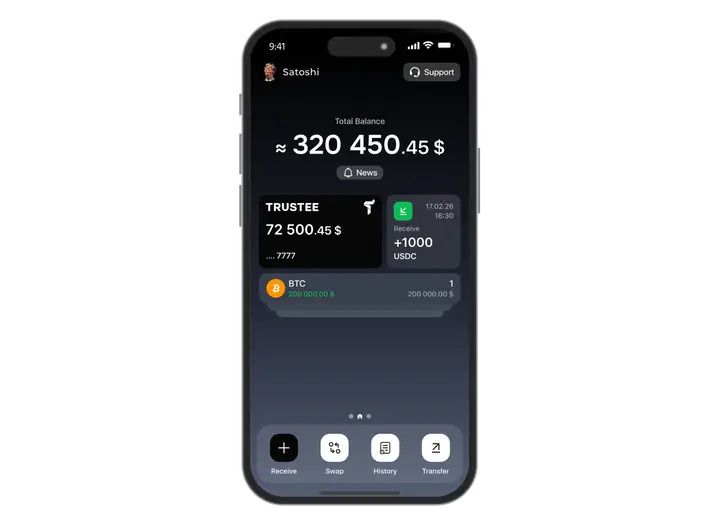
How to Install Trustee Plus
Installing Trustee Plus takes only a few minutes.
- Download and install Trustee Plus from the official app store.
- Register using your phone number, Apple ID, Google account, passkey, or Telegram.
- If you register with a phone number, confirm it via a phone call or SMS.
- Enter the remaining details and start using the app.
After setup, users can manage supported assets, exchange crypto, send transfers, check transaction history, and work with USDT across available networks.
Tips for Using USDT ERC20 Safely
Always check the network before sending or receiving USDT. The token name alone is not enough because USDT exists on several blockchains.
Make sure the receiving wallet supports ERC20. If the recipient gives you a deposit address, confirm that it is specifically for USDT on Ethereum.
Remember that ERC20 transfers usually require ETH for network fees. Without enough ETH, the transaction may not go through.
Use official apps and trusted platforms only. Fake wallet apps and phishing links are common risks in crypto.
If you are sending USDT to a new wallet or platform for the first time, consider starting with a smaller amount.
Final Thoughts
A Tether ERC20 wallet is useful for anyone who works with USDT on the Ethereum network. ERC20 is widely supported and compatible with many crypto services, but users should pay attention to network fees and address compatibility.
At the same time, modern stablecoin users often need more than one network. A wallet that supports USDT across several blockchains can make everyday crypto management easier and reduce the need for manual bridging.
Trustee Plus is a practical example of this approach. It supports USDT across popular networks, lets users manage USDT as one asset inside the app, and offers 0% commission on USDT–USDC exchanges. For users who regularly work with stablecoins, this can make crypto transfers and exchanges much more convenient.