What an AI Image Editor Does Not Change About Your Font License
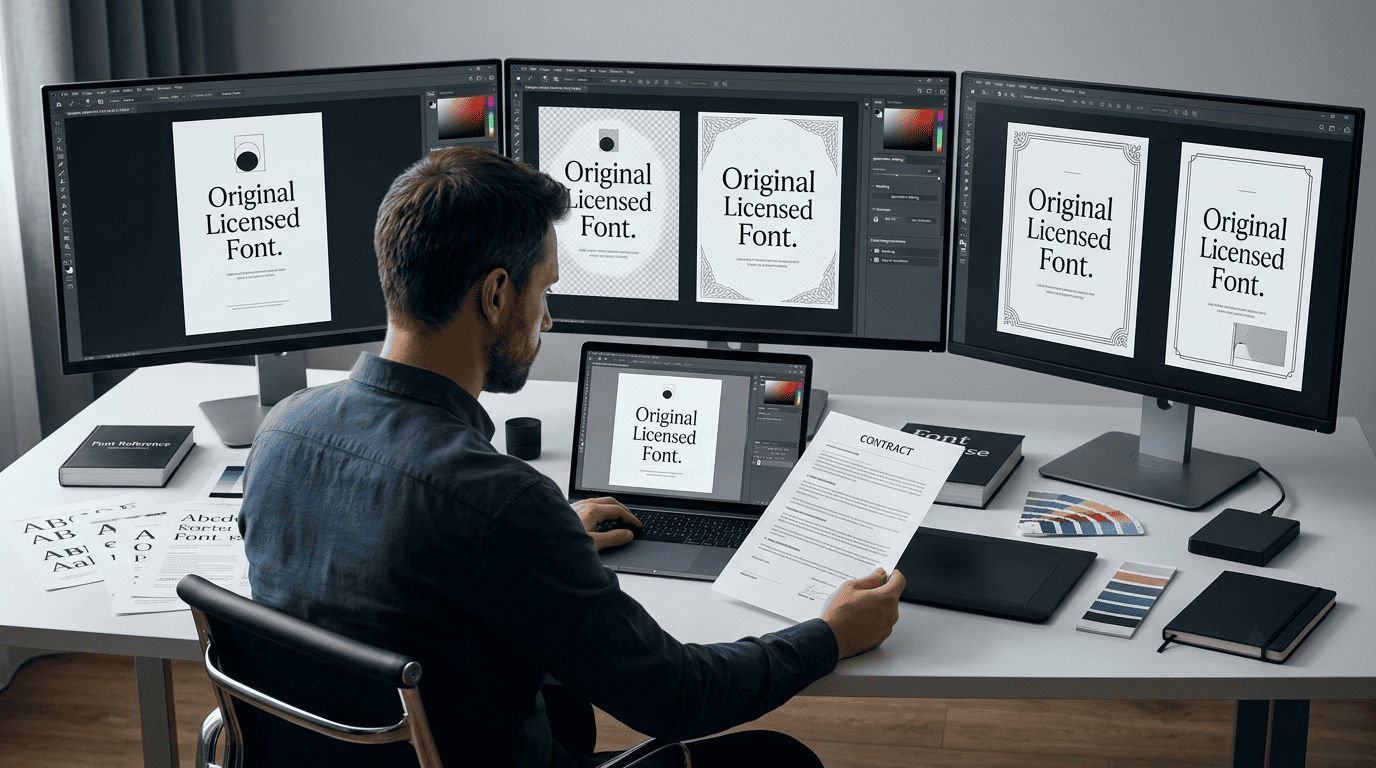
A designer makes a background in a generative tool, sets a licensed typeface over it, adds a stock element, exports a JPEG, and sends it to a client.
That single file now carries three separate sets of rights, issued by three different parties, on three different sets of terms. Most designers have read one of them.
This is not a new problem layered licensing has existed as long as stock imagery but generative tools have changed the volume and the speed. Producing the picture used to be the slow step, and the slow step was where people paused to think. Now the picture takes a minute and the pause has gone with it.
An AI Image Editor supporting practical design workflows with Higgsfield is genuinely useful in a working design process. What it does not do is alter, extend, or replace the license on the type you set over the result, and being clear about that boundary keeps a project clean.
What does one deliverable actually carry?
Three layers of rights, at least, and they do not travel together.
The image rights, from whatever tool or library produced the picture. Generative platforms differ on this, and commercial usage terms often vary between consumer and business tiers.
The font license, from the foundry, governing what you may do with the typeface and in which contexts.
Any third-party elements stock photography, icons, illustrations each with their own terms.

They expire differently, they scale differently, and they are enforced by different people. A generated background with unrestricted commercial rights sitting under a typeface licensed for desktop use only is a perfectly ordinary situation with one weak link in it.
Which license covers ordinary design work?
A desktop license, in most cases, and it covers more than designers assume.
A desktop license lets you install the font on a set number of machines and use it to create images, documents and printed material posters, brochures, business cards, signage, packaging, point-of-purchase material. Licenses are counted by seats and are cumulative, so adding a designer means adding a license.
It does not cover web embedding. This is described across the licensing literature as the most common mistake in the field: a desktop license does not automatically permit webfont use. Putting a typeface into a site’s CSS requires a separate webfont license, frequently limited by page views or by domain, and often on an annual rather than perpetual basis.
It does not cover app embedding, which needs its own license, or electronic publications, which are usually licensed per publication.
And logos are frequently separate. Many foundries treat logo use as a premium license, and some prohibit it outright for particular typefaces, because a logo is permanent in a way a poster is not.
Two further points worth holding onto. Licenses are not standardized; two typefaces at the same price from two foundries can carry entirely different terms. And you may not give the font files to your client. That restriction is close to universal.
What happens when the client wants the file?
Here is the distinction that matters most in practice, and it is where the AI workflow quietly creates exposure.
Delivering a flattened file is fine. A client receiving a JPEG, a PNG or a properly embedded PDF does not need their own font license. The type has been rasterized or embedded, and the font software has not changed hands.
Delivering an editable file is not. The moment a client receives a working file with live type and needs the fonts to open it correctly, they require their own license.
Rasterising or outlining type has a further nuance. You may modify and decorate outlined type freely, and the resulting image can be copyrighted, trademarked and used commercially. What you may not do is reconstruct font software from those outlines. Outlining reduces some distribution problems; it does not dissolve the license.
Why this bears on generative workflows: clients increasingly expect editable deliverables, and a process built around fast iteration in an AI Image Editor tends to produce more files, shared more casually, more often. The convenient move is to send the working file. That is the move that requires a conversation about licensing.
Does an AI Image Editor change any of that?
No. Not in either direction, and this is worth stating plainly because both errors circulate.
An AI Image Editor does not grant you font rights. Editing a generated image, however extensively, has no bearing on what license the typeface over it requires.
An AI Image Editor does not remove them either. A generated background does not make the type on top of it unlicensed or exempt.
What an AI Image Editor actually does in this workflow is the picture exposure, color, composition, cleanup, variants, formats. That is genuinely valuable and it is a separate layer of the file from the type.
Some platforms present this within a broader AI creative suite, where the generation, the correction and the export sit together. Higgsfield is one, and the practical benefit for a designer is fewer round trips between applications, not a change in what rights attach to the output.
The useful mental model: an AI Image Editor owns the pixels underneath. The foundry owns the letterforms on top. Neither one is a substitute for the other and neither one licenses the other.
What about lettering the model renders itself?
A real question now is that image models render text competently, and the answer has two halves.
Legally, generated lettering is not a font. It is pixels arranged to look like type. No font software was used, so no font license applies to it.
Practically, it is not type either, and this is the part designers care about more.
Generated lettering cannot be edited, re-kerned, re-set at a different size, or reused across a project. It is not a typeface you can apply to the next piece. It has no italic, no weights, no consistent spacing behaviour. It exists once, in that image, at that size.
For a background flourish or a texture, that may be sufficient. For anything with a typographic requirement hierarchy, a brand voice, consistency across a set of deliverables, accessibility, a client who will need it updated next quarter it is not a substitute for licensed type. It is a picture of some letters.
Which is the honest reason a foundry and an image tool are not in competition. They produce different things that happen to look similar in one narrow case.
What changes when the work is a template rather than a finished piece?
Worth its own section, because a foundry’s own customers include a great many people selling design assets rather than finished work, and the rules are stricter there.
Most commercial font licenses restrict redistributing fonts inside template products. Selling a social media pack, a presentation deck or a canvas template that ships with the font files bundled in is a distribution question, not a usage one, and the standard desktop license does not cover it.
Outlining helps and does not solve it. Converting type to vector shapes produces artwork rather than font software, which reduces the distribution problem. It does not automatically make the arrangement licensed, and it removes the buyer’s ability to edit the text which for a template is usually the whole point.
The workable pattern for anyone selling templates is to build the layouts around a typeface the buyer licenses separately, name it clearly in the product description, and link the buyer to the foundry. That is better for the buyer, better for the foundry, and it keeps the seller out of a redistribution argument.
Where an AI Image Editor sits in this is the same place as everywhere else in the article. It produces the backgrounds, the textures and the imagery inside the template, which are your assets to license out under the Higgsfield or equivalent commercial terms. It has nothing to say about the typeface, and a template that bundles a font is a licensing problem regardless of how the pictures were made.
Where does merchandise sit?
In its own category, and it catches people out regularly.
Promotional items given away free are generally covered by a desktop license.
Goods sold where the typeface is the primary design element, a slogan across a t-shirt, text on a mug frequently require a separate merchandise or extended license. The reasoning is that the typeface is doing the selling rather than supporting it.
Packaging and point-of-purchase material usually sit within a standard desktop license.
The distinction is roughly whether the type is the product or a component of it. An AI Image Editor producing artwork for a print-on-demand range does nothing to change which side of that line the type falls on.
And template products are stricter again. Many commercial licenses restrict redistributing fonts inside template products, which matters to anybody selling design assets rather than finished work.
What about motion and video?
A separate license in most cases, and the reason is distribution rather than software.
Type used in broadcast, streaming, film, large-scale advertising or motion graphics is usually covered by its own license tier. As one licensing guide puts it, even if you are “just using it in After Effects,” what matters is the distribution format rather than the application.
That applies equally to type set over generated video. The picture being produced by a model changes nothing about the type moving across it.
What should never be asked of a model?
Two things, and the first is specific to this audience.
Never ask a model to reproduce a named commercial typeface. Asking for lettering “in Helvetica” or in a specific foundry’s release is a request to imitate somebody’s product. It will not produce that typeface, it will produce an approximation, and the intent is the problem regardless of the output.
Never treat generated letterforms as a starting point for a font. Building font software from generated outlines sits in the same territory as building it from a licensed typeface’s outlines, which every EULA prohibits. If you want a typeface, license one or draw one.
Beyond those, ordinary practice applies. Read the EULA of the specific font, because they genuinely differ, and read the commercial terms of the image platform’s tier you are actually on.
How do you keep a project clean?
A short discipline that costs almost nothing at the start of a job and a great deal at the end of one.
Record the licenses at the point of use. A line in the project file: which typeface, which license tier, which AI Image Editor, which account tier. Two minutes, and it answers the question a legal review asks eighteen months later.
Decide the deliverable format early. Flattened or editable changes what the client needs, and it is easier agreed at briefing than discovered at handover.
Check the tier you are actually on. Commercial usage rights on an AI Image Editor often differ between free, personal and business plans. Higgsfield and comparable services publish theirs; the failure is not reading them rather than not having them.
Keep the working files, including whatever Higgsfield or your tool of choice retains. If a license question arises, being able to show what was used and how is the whole defense.
And ask the foundry. Independent foundries answer licensing questions directly and quickly, and a two-line email is cheaper than an assumption.
What to check before the next delivery
Three things, and they take about five minutes between them.
The font’s EULA, for this specific typeface, on the uses this project actually involves web, app, logo, merchandise, motion.
The AI Image Editor commercial terms, for the tier your account is on rather than the one on the marketing page. Higgsfield and its competitors all differ here.
The delivery format, and whether the client will need their own font license as a consequence.
An AI Image Editor has made the picture part of this work dramatically faster, and Higgsfield or a comparable tool will keep making it faster. The licensing underneath has not moved at all, which means the gap between how quickly work is produced and how carefully its rights are handled is widening.
Closing that gap is a five-minute habit. Letterforms are somebody’s product, and the person who drew them is generally very easy to ask.